
A Summer of Technology: Interning at the National Poultry Technology Center @ Auburn Univerity
- Amanda Burgett

- Aug 10, 2021
- 6 min read
Updated: Sep 21, 2021
On March 22nd, 2021, I began my internship at the National Poultry Technology Center (NPTC) at Auburn University through a Research and Extension Experience for Undergraduates (REEU). NPTC is a collaboration between the Alabama Cooperative Extension System and the Alabama Agricultural Experiment Station at Auburn University to educate commercial poultry growers and industry professionals in Alabama and beyond. NPTC hosts multiple workshops throughout the year to educate poultry growers and industry professionals locally and internationally. As an NPTC REEU Intern, I spent the summer effort evaluating the accuracy of control system sensors and developing materials to help poultry producers improve their efforts. I was trained on control systems and sensors used in precision animal management technologies. During this summer, I led the effort to develop a survey to further understand poultry grower’s technology usage and the challenges they face using technology. I was also allowed to develop a research article and poster to present at multiple meetings, including IPPE Expo in the Spring. The research poster and article are both titled: A Survey of Poultry Producers Technology Use and Challenges. I was also able to publish an extension article titled: NPTC Tools of the Trade: Measuring Air Infiltration. As a side project for the summer, I created a 360-degree virtual tour of a brand new 60 x 600 poultry house to use for educational purposes. This project was very fun and opened the door to a lot of new opportunities that could be used in today's world.
My survey of poultry producer’s technology use and challenges was sectioned into three portions. The first portion collected background information on the individual producer. Questions like age, gender, and education were asked. The following section was based on labor intensity. We wanted to gain more knowledge on how labor-intensive their farm was and how demanding each farm was with outside operations or jobs. The following sections were organized by which sensors the producer used on their commercial broiler farm. The entire goal of the survey was to further prove that sensors on farms were not calibrated/accurate and that most of the data collected on-farm were not being utilized.
Although I had projects of my own to complete, I also worked with five other interns to assist with their research efforts. Each intern had a separate project that was conducted throughout the summer. This summer, we visited seven farms from a South Alabama Wayne Farms complex to research each project. These research days were spent traveling 2 hours to the farm, working for 10 straight hours, and then driving the 2 hours back to Auburn, AL. They were long, hot days filled with conducting individual research studies. I assisted with each study.
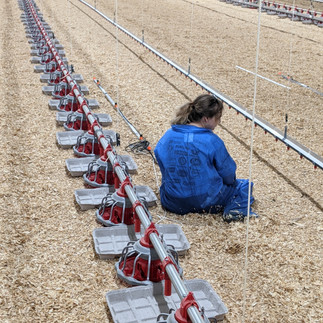
Abigail Lane, a Biological & Agricultural Technology Management Major (BATMan), was charged with A Survey of Light Uniformity in Commercial Broiler Houses as her project. To execute this research, we constructed light meter robs, 10 ft in length, that had three sensors on them each 5ft apart. The sensors were connected to a Li-Cor light reader that measured in Kila-Lux. We measured light uniformity in each house on the farm by measuring in three sections of the house: Front, Middle, and End. We measured brood lighting only in the Front and Middle, since all seven of the farms we visited brooded in the front of the house. We measured the tunnel, or grow-out, lighting in all three sections. With seven people manning a pole in each section, it was still a tiring process to collect the data at each collection point. Each pole was positioned either directly under the lighting or in-between lighting. To guarantee our data was as accurate as possible, we had to lie very close to the ground in the litter.
Baylor Arnold, also a BATMan Major, whose project for the summer was A Survey of Gas Line Leakage in Commercial Broiler Houses. Armed with dish soap, glycerin, water, and a pump sprayer, we went around the outside of each house counting the number of fitting and spraying them to detect gas leakage. The major proven finding of his research was that the older the house, the more leaking gas line fitting. This research was to prove the importance of gas line inspection and the cost associated with losing the amount of gas.
Julianna Rezek, a General Agriculture Sciences Major, whose project was An Assessment of Static Pressure Sensor Accuracy in Commercial Broiler Houses. She used a calibrated static pressure meter and compared it to the static pressure meter installed in each broiler house. One of the main points of the summer was to prove that technology in broiler houses needs to be calibrated. Juliana’s report proved that most static pressure meters on poultry farms were not accurate.
Drew Johnson, a Bioprocess Engineering Major, oversaw An Assessment of Water Meter Accuracy in Commercial Broiler Houses for his summer project. This project aimed to create a reliable method for testing broiler house water meters and then determining the accuracy of various brands and ages of water meters. This research proved the unreliability of on-farm meters when tested against calibrated meters. The reliability of water meters on farms is important to ensure animal welfare. Most companies thoroughly track bird water consumption for this reason.
And lastly, fellow Poultry Science Major, Leah Smith’s project was An Assessment of Temperature Sensor Accuracy in Commercial Boiler Houses. This project used converted fishing carts equipped with generators and a Fluke Temperature Calibrator to test the accuracy of the sensors against a calibrated and accurate meter. This project highlighted a trend across all seven farms. The temperature sensors, regardless of brand, would read higher than the calibrated meter on lower temperatures, and then would read lower than the calibrated meter on higher temperatures. This trend was not expected.
I not only was able to participate in these six research efforts this summer, but I also was able to participate in other activities as well. On June 4th, I assisted in a Wayne Farms Extension Program for Broiler Service Technicians. At this program, I helped educate Broiler Service Technicians on common water problems in commercial poultry houses. I was also allowed to travel on June 24th and 25th to North Alabama to visit the Cumberland manufacturing plant in Bremen, AL, and Aviagen’s research facility in Albertville, AL. I also assisted in training Masters of Avian Medicine students internationally on poultry housing technologies. The last event of the summer was getting a visit from Chore-Time associates on July 26th. They trained us on their control systems using simulators. I especially found this helpful. Learning to install the temperature sensors and other sensors to the controller was something I had never learned. Over the summer, I appreciated just how important these control systems were to growers. Being allowed to learn in-depth about how these controllers work and getting to program them, I felt was one of the most beneficial experiences of the summer. My friends that were already working in the industry had expressed how important learning to use controllers was. This made me very grateful for the training.
In all, I enjoyed my summer learning about poultry housing technologies. I was able to get a more in-depth view of working in the live side of the industry and precision animal management technologies. This internship correlated directly with BSEN 5450 which I completed in the Fall of 2019. I will be honest and say that this experience made me question my choice in bachelor's degrees more than once. Because I fell in love with technology, I realized that I may have been happier if I would have pursued a more technology-based degree such as Biosystems Engineering or BATMan. Most of the job opportunities that are based on technology require a different degree. This internship also intrigued me to investigate careers in journalism. After publishing my first extension article, I realized I enjoyed the editorial process. Since my job podcasting, I have been fascinated with social media marketing and blogging. This summer opportunity shaped the path that I would like to pursue in the future and opened my eyes to more possibilities in journalism and technology. I am thankful for the experience and appreciate the work that NPTC does for the industry. The research they conduct is important for the growth and future of the industry. The industry needs to be mindful and selective about the technology and data it invests in. NPTC does a wonderful job of researching technologies and educating the industry in much-needed areas.







Comments